BRING YOUR VISION INTO ACTION
Do you often play brilliantly in the opening and middle game, only to watch your advantage slip away when the pieces come off the board? You are not alone. For many players, the endgame feels dry, complicated, and frustrating. But what if you could see the board differently?
At Chess Visionaries, we know that mastering the final phase of the game is the ultimate cheat code to boosting your chess rating. The greatest players in history didn’t rely solely on middle-game tactics; they relied on rock-solid endgame principles.
Here is a Grandmaster-recommended complete endgame system that will transform how you evaluate and play reduced-material positions.
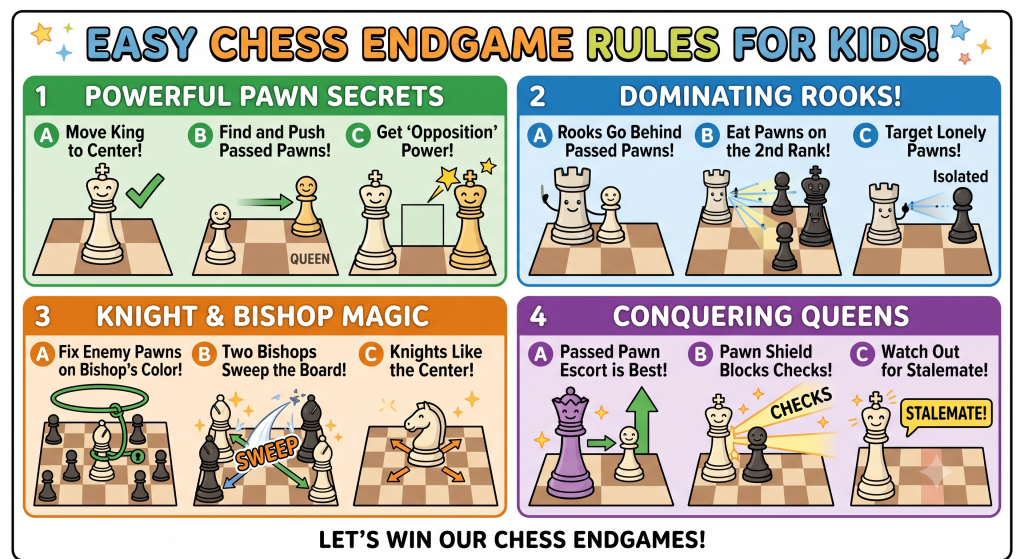
1. Mastering Pawn Endgames
Pawn endgames are the foundation of all chess strategy. Every other endgame eventually simplifies into a pawn endgame, making these rules non-negotiable:
- Centralize Your King: In the endgame, the threat of checkmate drops dramatically. It is time to develop your King! Move it off the first rank and toward the center where it becomes an active attacking piece.
- Identify and Push Passed Pawns: A passed pawn (a pawn with no opposing pawns to block it) is your golden ticket. Push it forward aggressively to force your opponent into a defensive posture.
- Win the Opposition: When Kings face off with one square between them, the player whose turn it is to move is in zugzwang (forced to make a disadvantageous move). Claiming the opposition allows your King to infiltrate enemy lines.
2. Dominating Rook Endgames
Rook endgames are the most common endgames in competitive chess. Knowing how to handle them will save you from countless lost positions.
- Rooks Belong Behind Passed Pawns: Whether you are supporting your own passed pawn or defending against your opponent’s, always place your rook behind the pawn. This gives your rook maximum flexibility while restricting the enemy.
- Target the 2nd Rank: Invading the opponent’s second rank (or seventh rank for White) is devastating. It traps the enemy King and allows your rook to feast on vulnerable pawn chains.
- Target Isolated Pawns: Rooks excel at attacking from a distance. Seek out “pawn islands” or disconnected pawns and pile the pressure on them.
3. Navigating Knight and Bishop Endgames
Minor piece endgames require sharp calculation and an understanding of piece harmony.
- Fix Enemy Pawns on the Bishop’s Color: If you have a dark-squared Bishop, force your opponent to lock their pawns on dark squares. This turns their pawns into permanent targets while keeping your pawns safe on light squares.
- The Power of the Bishop Pair: In open positions with pawns on both sides of the board, Bishops easily overpower Knights. Two Bishops working together can sweep the entire board.
- Keep Knights Central: A “Knight on the rim is dim.” Keep your Knights centralized, as they struggle immensely to stop passed pawns on the A or H files.
4. Conquering Queen Endgames
Queen endgames are highly volatile, but keeping a cool head will secure the victory.
- Passed Pawns Trump Material: In a Queen endgame, having an advanced passed pawn is often more valuable than being up one or two regular pawns. The Queen’s power guarantees excellent escorting capabilities.
- Use the King Shield: Don’t fear endless checks. March your King up the board and use your own passed pawn as a physical shield against the enemy Queen’s attacks.
- Beware the Stalemate: Because the Queen controls so many squares, it is incredibly easy to accidentally stalemate a cornered enemy King. Always double-check your opponent’s legal moves before finalizing yours!
Endgames don’t have to be intimidating. By applying these fundamental Grandmaster strategies, you will start seeing chess in a completely new way: clearer, more logical, and far more winnable.
Ready to take your game to the tournament level? Join us at Chess Visionaries today and let our coaching team turn your endgame weaknesses into your greatest strengths!